2026 is the year delivery stops being “marketing” and becomes operations
If you’re running a restaurant in MENA, you’ve already lived through the first wave of delivery: sign up for an app, get more orders, pay the commission, hope the unit economics still work.
In 2026, that playbook is aging out.
The region’s food delivery market is still growing, but it’s also maturing. Customers are more price-sensitive. Aggregators are more fee-heavy. Competition is tighter. And the winners aren’t the restaurants with the “most platforms” - they’re the restaurants with the best system.
This guide breaks down the most important restaurant delivery trends 2026 owners should care about in the MENA food tech landscape - and what to actually do about them. (Not vague predictions. Practical moves.)
Trend #1: Direct ordering growth is becoming the default, not the exception
“Direct” (first‑party) ordering used to be a nice-to-have: a link on Instagram, a basic menu page, maybe a phone number in bio.
Now it’s a strategic channel.
Why direct ordering is accelerating in MENA:
- Margins are thin: When your average delivery order has a commission, a service fee, a marketing fee, and a payment fee layered on top, you start designing your entire business around fees instead of food.
- Platforms don’t share the relationship: If you can’t message your best customers, you can’t build retention. You’re stuck paying to reacquire the same people again and again.
- Consumers are multi-homing: People will order from whichever app has the best deal today - which means the algorithm is basically your “partner.” That’s not a business you can control.
Direct ordering doesn’t mean “quit aggregators.” It means you stop renting your growth.
How to win direct ordering without discounts
Your best lever is not “10% off.” It’s convenience: fast loading, one-tap reorder, clear delivery zones, accurate ETAs, and a checkout that doesn’t fight the customer.
What this looks like in practice in 2026:
- A branded ordering page (web or app) that feels like your restaurant, not a marketplace listing.
- A single menu system that stays accurate across all channels.
- A re-order experience that’s actually easier than the aggregator (saved orders, favorites, quick add-ons).
- Loyalty and referral loops that only work on direct orders (points, stamps, free item after X orders, invite-a-friend credits).
If you’re not measuring direct order share yet, start. It’s going to become a core KPI the same way “food cost %” is.
Trend #2: Commission fatigue is real - and it’s changing behavior
Restaurants across MENA are getting smarter about platform economics. The question isn’t “is delivery worth it?” - it’s “which orders are worth it?”
In 2026, more operators are segmenting by channel:
- Aggregator orders are treated as acquisition (new customers, new neighborhoods, new timeslots).
- Direct orders are treated as retention (repeat customers, higher margin, higher LTV).
That segmentation creates leverage. If you can prove that your direct channel can capture repeat demand, you can negotiate aggregator terms from a stronger position.
Here’s the uncomfortable math that pushes this trend:
- When commissions land in the 15-30% range, you either raise prices on the platform (risking conversion), reduce portion quality (hurting brand), or accept that delivery is a low-margin product line.
- Many restaurants aren’t actually losing money on the first order - they’re losing money on the repeat orders they keep paying commission on forever.
The healthiest channel mix we see
Use aggregators to get discovered, then convert customers to direct ordering with a better experience, a loyalty program, and clear reasons to switch (faster support, better accuracy, exclusive items, loyalty rewards).
Trend #3: Multi-channel ordering is mandatory - but “multi-system” is a trap
Restaurants don’t just have “delivery” anymore. You have:
- dine-in
- pickup
- delivery via apps
- delivery via direct ordering
- WhatsApp / social orders
- corporate / catering
In 2026, customers expect you to be reachable everywhere. But the operational cost of managing five disconnected systems is brutal: duplicate menus, mismatched prices, modifier chaos, missed orders, angry staff, refund leakage.
So the winning pattern is:
Multi-channel demand, unified back office.
What to unify:
- Menu + modifiers (the hard part)
- Hours / availability (86’d items should not show as “available”)
- Taxes / service charges
- Order status & customer updates
- Reporting (you can’t improve what you can’t see)
If your direct ordering channel isn’t connected to your operational reality (prep times, stock, capacity), you’re not building a “channel.” You’re building a support queue.
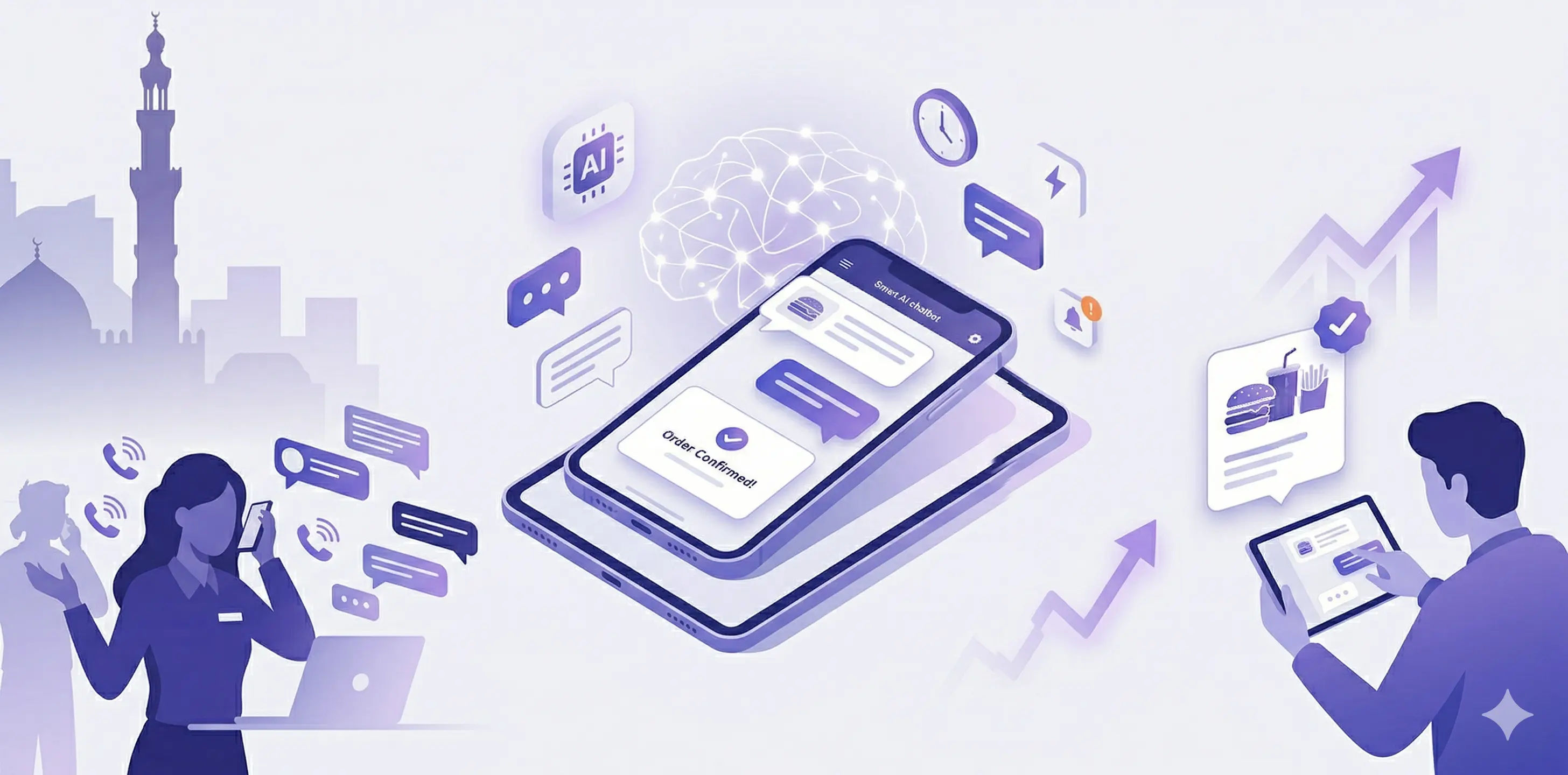
Trend #4: AI is moving from “marketing hype” to menu engineering
AI in restaurants isn’t just chatbots. The most useful applications in 2026 are boring (and that’s why they work):
- predicting best sellers by daypart
- recommending add-ons at checkout
- rewriting item descriptions for conversion
- identifying items that create kitchen bottlenecks
- detecting weird patterns (refund spikes, late orders, driver delays)
The reason AI matters for delivery specifically: delivery is a data-rich channel. You see what people browse, what they abandon, what they reorder, which promos work, which neighborhoods tip, what times are chaotic.
If you own that data, you can optimize. If you don’t, you’re guessing.
AI can’t fix a broken menu
Before you “optimize,” make sure you have: clear item photos, sensible modifier structure, realistic prep times, and a checkout flow that’s frictionless on mobile.
Trend #5: WhatsApp and social commerce keep growing (because that’s how MENA communicates)
In many MENA markets, WhatsApp is where business happens: families coordinate dinner, offices plan lunch, friends send recommendations, and customers message restaurants like they’re talking to a person - because they are.
In 2026, WhatsApp ordering is evolving from “manual chat” into a real flow:
- automated menu links
- click-to-order from Instagram stories
- quick replies for common questions
- order confirmation + status updates
- support that feels human (without the chaos)
The key move is not to force customers into a channel they don’t want. It’s to give them a fast path from “message” to “order placed”.
Practical setup:
- Put a direct ordering link in WhatsApp auto-reply (“Tap to order in 30 seconds”).
- Use WhatsApp for support and retention, not manual order entry.
- Route payment to your storefront checkout instead of collecting addresses in chat.
Trend #6: Delivery is becoming a brand experience (not just a transaction)
The biggest mistake restaurants make with delivery: treating it like “food in a bag.”
In 2026, delivery is a brand touchpoint, and customers judge you on:
- accuracy (did I get what I ordered?)
- reliability (ETA realism)
- packaging (temperature, spill resistance, presentation)
- support (how fast you respond when something goes wrong)
Aggregators can help with discovery, but they don’t protect your brand when something breaks. The complaint still lands on your restaurant.
What top operators do:
- design packaging like a product (not an afterthought)
- reduce SKU chaos (fewer high-variance items during peak delivery hours)
- standardize modifiers (so “no onion” doesn’t become a kitchen argument)
- offer instant “make it right” paths (replacement / credit) on direct orders
Trend #7: The unit economics focus is shifting from “commission” to “contribution margin per hour”
A lot of restaurants talk about commissions as a percentage. But the more mature operators in 2026 look at delivery like capacity planning:
What’s my contribution margin per kitchen hour?
That changes decisions:
- You might drop low-margin items from delivery menus during peak.
- You might encourage pickup for far zones (or charge a realistic delivery fee).
- You might batch deliveries by zone/time to reduce late orders.
And it changes channel strategy:
- Aggregators might be worth it during off-peak to fill capacity.
- Direct ordering might be prioritized during peak because it’s more profitable and you control the support.
Trend #8: Sustainability becomes less “PR” and more “cost control”
Eco-friendly delivery is a real consumer preference, but in 2026 it’s also operational:
- packaging costs are up
- customers complain about waste
- regulators are paying more attention to plastics and waste management
What works without killing margins:
- switching to fewer, better packaging SKUs (less variety, lower error rate)
- “sauce policy” (default fewer containers, opt-in extras)
- designing packaging that reduces remakes (spills are expensive)
- offering pickup incentives (sustainability + margin win)
What this means for restaurant owners (a 90-day plan)
If you’re reading this and thinking “cool trends, but I have service in two hours,” here’s what to do first.
Step 1: Choose your direct ordering goal
Pick one measurable target:
- “Get to 20% direct order share”
- “Convert 200 repeat customers to direct ordering”
- “Reduce aggregator dependency on weekdays”
Step 2: Make direct ordering objectively easier
- fast mobile page
- clear delivery zones
- simple modifiers
- one-tap reorders
- strong support (customers switch when they trust you)
Step 3: Build your conversion loop
- QR codes on receipts + packaging
- “Order direct next time” insert card
- loyalty program that only works on direct orders
- WhatsApp follow-up for support + reorders
Step 4: Track the right metrics
- direct order share
- repeat rate by channel
- refund/complaint rate by channel
- average prep time and late orders
- top 10 abandoned items/modifiers
How PlateForm helps you stay ahead in 2026
PlateForm was built for the direction MENA is heading:
- Commission-free direct ordering that looks like your brand (not a marketplace listing).
- Unified ordering experience so customers can order from your website and you keep control.
- Customer data ownership so you can run retention (loyalty, reactivation, referrals) instead of paying to reacquire.
- Operational clarity with reporting that helps you improve menu performance, not guess.
If you want to build a direct channel without turning your restaurant into a software project, this is the path.
Start simple, then scale
Launch with your best sellers, one delivery zone, and one retention offer. Complexity kills adoption. You can expand after you’ve proven the loop works.
Final takeaway
The biggest MENA food tech shift in 2026 isn’t a new app. It’s that restaurants are rebuilding their delivery business around ownership:
- owning the channel (direct ordering)
- owning the relationship (customer data)
- owning the economics (margin per hour)
- owning the experience (support + packaging + reliability)
That’s how you grow delivery without letting delivery own you.
Ready to future-proof your restaurant? Talk to PlateForm or see what a commission-free system looks like.